How Long Does a Divorce Case Take in Delhi Courts?
If you are seriously considering divorce, or already in the middle of it, one question tends to dominate everything else- how long is this going to take? And that question matters, not just practically, but emotionally. When your life is in a holding pattern, waiting for a legal process to conclude, the uncertainty alone can be exhausting.
The honest answer is that it depends, and it depends on quite a few things. But vague answers do not help you plan. So let us break this down properly, with realistic timelines, the factors that influence them, and what you can actually do to avoid unnecessary delays.
If you are in Delhi and trying to figure out your legal options, speaking with a top divorce lawyer in Delhi who knows the family courts here is the best starting point. AM Legal handles both mutual and contested divorce cases across Delhi, and our team can give you a clear picture of what your specific situation looks like. Do not wait until the process has already begun to get proper legal advice.
The Two Categories of Divorce in Delhi: Mutual and Contested
Every divorce in Delhi falls into one of two broad categories, and which one applies to you determines almost everything about the timeline, the cost, and the emotional weight of the process.
A mutual consent divorce means both spouses agree to end the marriage and have already worked out, or are willing to work out, the key terms: alimony, child custody, and property division. A contested divorce is when one spouse does not agree to the divorce itself, or when there are serious disagreements over the terms that cannot be resolved without court intervention.
The difference in timeline between these two is not small. It can be the difference between a few months and several years of your life.
Mutual Consent Divorce in Delhi: The Faster Route
If both of you genuinely want to end the marriage and can agree on the major financial and custody terms, a mutual consent divorce is by far the most sensible path. It is faster, cheaper, less adversarial, and keeps your private life out of long public court hearings.
What the law requires
Under Section 13B of the Hindu Marriage Act, 1955, both spouses must have lived separately for at least one year before filing. They file a joint petition in the appropriate Delhi family court, which may be Tis Hazari, Saket, Rohini, or Dwarka, depending on where the marriage took place or where the couple last lived together.
The typical timeline
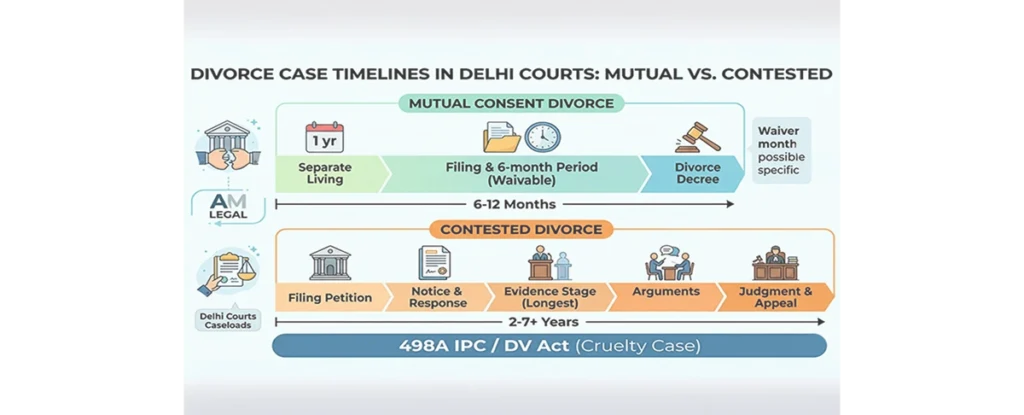
- Joint petition is filed and the court fixes a date for the first motion
- First motion: both spouses appear, make statements confirming they want the divorce, and the court records them
- Six-month cooling-off period: this waiting time is mandatory under the law and is meant to allow the couple to reconsider
- Second motion: if both parties still want to proceed after the six months, they appear again, the court records their final statements, and the divorce decree is passed
Total realistic timeline: 6 to 12 months under normal circumstances.
Can the six-month wait be skipped?
Yes, in certain situations. The Supreme Court in Amardeep Singh v. Harveen Kaur (2017) held that the six-month cooling-off period is not mandatory in all cases and can be waived by the court if the marriage has clearly broken down irretrievably. Courts in Delhi have applied this consistently since then.
More recently, a Delhi High Court ruling in December 2025 further expanded the grounds on which waivers can be granted, including situations of exceptional hardship and cases where both parties have been living separately for an extended period with all settlement terms already agreed upon. With a successful waiver, a mutual divorce in Delhi can be concluded in as little as 3 to 4 months from the date of filing.
This is genuinely fast for a legal process of this significance. If you and your spouse are on the same page about ending the marriage and the terms, the best divorce law firms in Delhi will help you structure the petition, the settlement agreement, and the waiver application in a way that minimizes delays.
Contested Divorce in Delhi: The Longer Road
A contested divorce is a different experience entirely. When one spouse does not agree to the divorce, or when there are serious disputes over alimony, child custody, or property, the case becomes a full civil trial. These cases proceed through multiple stages, and at each stage, delays can accumulate.
The stages of a contested divorce in Delhi
- Filing the petition: the petitioner files for divorce on one of the legally recognised grounds under Section 13 of the Hindu Marriage Act, which include cruelty, adultery, desertion, mental illness, or conversion
- Service of notice: the court issues notice to the respondent, who must be formally served before the case can proceed
- Written statement: the respondent files their reply, usually within 30 days of receiving notice, though this is often delayed
- Framing of issues: the court identifies the core disputes that need to be adjudicated
- Evidence stage: both sides file affidavits, produce documents, examine witnesses, and cross-examine the other side’s witnesses. This is typically the longest stage of a contested divorce
- Final arguments: lawyers for both sides make oral arguments based on the evidence on record
- Judgment: the court delivers its decision, usually within a few months of final arguments
- Appeals: if either party is dissatisfied with the judgment, they can appeal to the Delhi High Court, and further to the Supreme Court, which adds years to the timeline
Realistic timeline for contested divorce in Delhi
If everything moves relatively smoothly, a contested divorce in Delhi can conclude in 2 to 3 years. In cases with more complex disputes, significant assets, or contested child custody, 4 to 7 years is not unusual. Cases that reach the High Court on appeal can extend further.
Delhi’s family courts carry heavy caseloads. Frequent adjournments, court vacations, changes in judges, and the sheer volume of pending matrimonial cases all contribute to delays. This is the reality of litigation in the capital, and any lawyer who promises you a quick contested divorce without qualification is not being straight with you.
When Criminal Cases Run Alongside Your Divorce
In a significant number of contested divorces in Delhi, criminal proceedings are filed alongside the matrimonial case. Allegations of cruelty under Section 85 of the Bharatiya Nyaya Sanhita (formerly Section 498A IPC), domestic violence under the Protection of Women from Domestic Violence Act, and dowry harassment are among the most common cross-cases.
When this happens, you are no longer dealing with one legal proceeding. You are simultaneously navigating a family court case and a criminal matter in a different court, with different procedures, different judges, and significant overlap in the evidence. The criminal case can directly affect bail conditions, travel permissions, and even the tone and strategy of the matrimonial case.
In these situations, having the best criminal lawyers in Delhi working in coordination with your family law advocate becomes critical. A family law advocate who does not understand criminal procedure, and a criminal lawyer who does not understand matrimonial law, working in silos, can create gaps in your legal strategy that are difficult to recover from. Firms like AM Legal that handle both family law and criminal matters are better positioned to protect your interests across both proceedings simultaneously.
It is also worth noting that the way a criminal case is handled can have downstream consequences on the divorce decree, the alimony quantum, and custody decisions. Courts consider the conduct of both parties, and adverse findings in a criminal matter can influence a family court judge’s view of the case. This is precisely why the best criminal lawyers in Delhi who work alongside matrimonial advocates tend to produce better overall outcomes for their clients in complex cross-case situations.
What Makes Your Case Faster or Slower?
There are several factors within your control, and several that are not. Understanding both helps you plan realistically.
Factors that can delay your case
- Frequent adjournments requested by either party, which add weeks or months each time
- Delay in service of notice to the respondent, especially if they are uncooperative
- Heavy backlog at the specific family court handling your case
- Complex disputes over assets, business valuations, or overseas property
- Non-cooperation by the respondent at the evidence stage
- Appeals filed against interim orders for maintenance or child custody
Factors that can speed things up
- Moving to mediation early: Delhi courts actively promote mediation, and a skilled mediator can help resolve disputes over alimony and custody in weeks, converting a contested case into an agreed settlement
- Having all documentation in order from day one: correctly filed petitions with complete supporting documents reduce procedural rejections and delays
- Choosing counsel with strong familiarity with the specific family court handling your case: experienced advocates know how to navigate posting dates, avoid unnecessary adjournments, and push for early hearings
- Responding promptly to every court notice and order rather than seeking time
What About Interim Orders While the Case Is Going On?
One of the practical realities of a long contested divorce is that life does not pause while the case is pending. There are children to care for, a home to manage, and financial needs that cannot wait years for a final judgment. Delhi family courts address this through interim orders.
Courts can pass interim orders for maintenance (Section 24), child custody, and possession of the matrimonial home even at the early stages of a contested case. A well-timed application for interim relief can provide significant financial and practical stability while the main case continues. A top divorce lawyer in Delhi will advise you on the right timing and grounds for such applications.
A Note on the December 2025 Delhi High Court Update
In December 2025, the Delhi High Court issued fresh guidelines streamlining aspects of the divorce process in Delhi, particularly around the mutual consent route. Courts were directed to take a more proactive approach to waiving mandatory waiting periods in cases where the marriage is clearly irretrievable, and to expedite interim orders in contested matters to prevent financial hardship during pendency. If you are filing or considering filing in 2025 or 2026, these guidelines work in your favour, and a current divorce lawyer in Delhi should be familiar with applying them.
The Bottom Line
There is no single answer to how long a divorce case takes in Delhi because every case is different. What you can control is the quality of preparation and the quality of legal representation you bring to the process.
A mutual divorce with proper legal guidance can conclude in a few months. A contested case handled well, with early mediation explored and no unnecessary delays on your side, can still be resolved in a reasonable timeframe. And in complex cases involving criminal proceedings, coordinated representation across both forums is not optional. It is essential.
AM Legal is one of the best divorce law firms in Delhi, with experienced advocates handling mutual divorces, contested matrimonial cases, interim maintenance applications, child custody disputes, and coordinated criminal defence when cross-cases arise. We understand Delhi’s family courts, we know the current legal landscape, and we will give you an honest picture of what your case realistically looks like.
Do not navigate this alone and do not go in without knowing what you are walking into. Contact AM Legal today for a confidential consultation.
Best divorce lawyers in Delhi – “https://amlegal.in/divorce-law-firm-in-delhi/“
Best criminal lawyers in Delhi – “https://amlegal.in/best-criminal-lawyer-in-delhi/“